Flexible modulation of sequence generation in the entorhinal–hippocampal system
- Post status: Nature link.
- In plain words: Your brain replays memories differently depending on what it’s trying to do.
- Why it matters: Connects replay regimes (superdiffusive, diffusive) to cognitive functions (foraging, consolidation).
They develop a theory of episodic memory sampling for optimal performance under different objectives:
Exploration, consolidation and planning depend on the generation of sequential state representations (…) We theorize how the brain should adapt internally generated sequences for particular cognitive functions and propose a neural mechanism by which this may be accomplished within the EHC.
Background on place/grid cells and EHC to follow this paper
Entorhinal-Hippocampal Circuit (EHC)
Handles replay memory, a temporally compressed representation of previously experienced trajectory embedded within hippocampal Sharp-Wave Ripples (SWRs). [ What does it mean to be embedded within here? ]
Initially observed during sleep, replay is thought to subserve long-term memory consolidation in neocortical networks.
While rodents quietly rest, ensemble place cell activity appears to random walk through a cognitive map of a familiar environment instead of veridically replaying a rodent’s physical traversals.
Modes of sequence generation
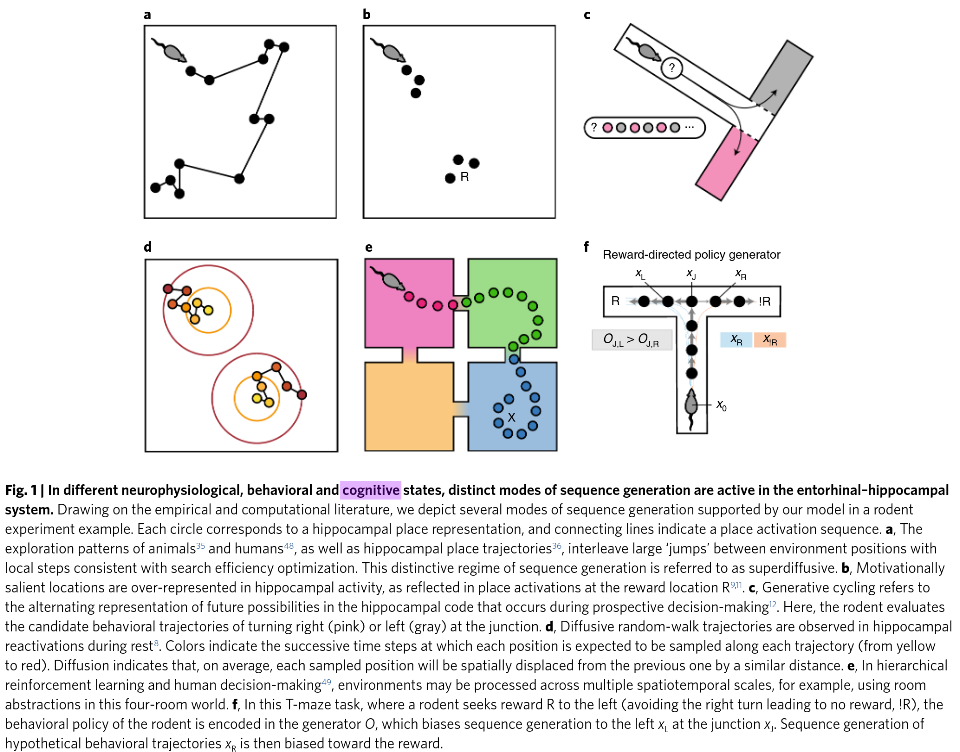
Hypothetical framework of rodent decision-making. (a) Superdiffusive (\(\alpha<1\)) regime: large jumps with local steps consistent with search efficiency optimization. (b) Rewards are overrepresented in place cell density. (c) Alternating locations during decision making. (d) During rest, rodent reactivates equally-spaced place cells (yellow-to-red). (f) Sequence generation biased toward the reward (left).
In all diagrams, time flows yellow-to-red:
\(x = (x_0, x_1, \cdots, x_t)\), where state space \(X\) is considered discrete. “Master equation” defined by e.g. rodent initial position \(\rho_0 = p(x_0)\); \(\tau \frac{d\rho}{dt} = \rho O\), with \(O\) an infinitesimal generator.
Analytic solution \(\rho_{\Delta t} = \rho_0 \exp\{\tau^{-1}\Delta t O\}\), which they call the “propagator” \(P_\tau\): \(x_{t+1} \approx 1_{x_t} P_\tau\). Here \(1_x\) is a one-hot vector indicating current state.
This generic framework can be adapted to different environments.
Foraging in an open environment
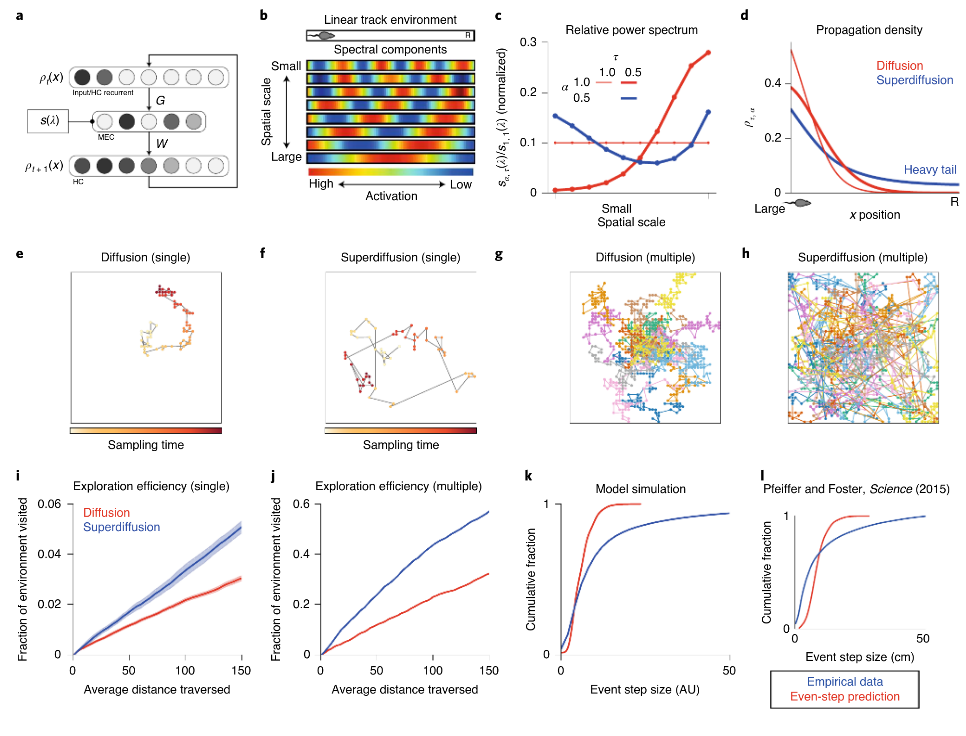
Superdiffusive. Trade-off between scales (Levy flight foraging hypothesis); interleaving \(\tau \rightarrow 0\) for large spatial scales with \(\tau \gg 0\) oversampling a small area. Levy is heavy-tailed; besides high probability of sampling a nearby position, it has a small probability of generating a large jump.
Theoretical analysis and simulations have shown that exploration efficiency is maximized by interleaving jumps (that is, sampling successive positions separated by a large distance) with local search patterns.
Based on some mathematical considerations, introduce param. \(\alpha\) s.t. \(s_{\tau,\alpha}(\lambda) = \exp \{ -\tau^{-1} |\lambda|^\alpha\). When alpha is less than 1, probability mass is distributed towards remote positions (fig 2d).
Goal-directed with heterogeneous jumps
Superdiffusive (heavy-tail) regime. CA1 activity of rats alternating random foraging and spatial memory tasks.
neural decoding analyses revealed the rapid sequential encoding of positions across the environment while the rats were task engaged but immobile.
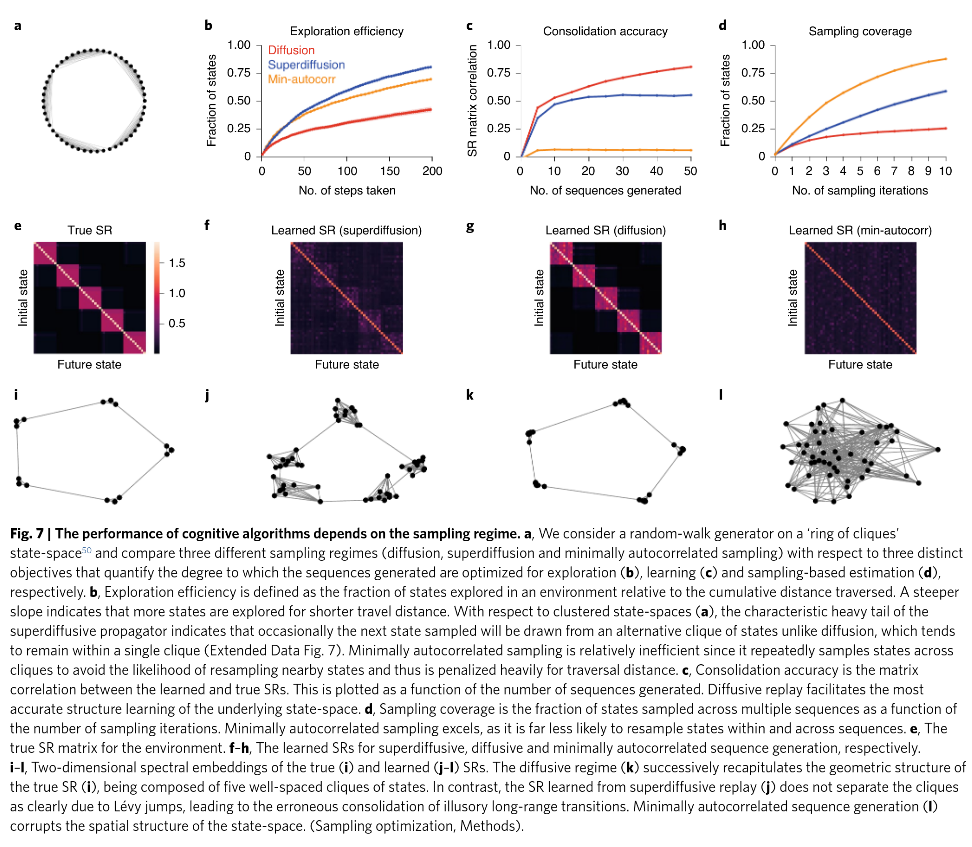
Diffusive reactivations for structure consolidation
Occuring during rest.
In an experiment where rats foraged for randomly dropped food pellets, spatial trajectories were decoded from SWRs during a postexploration rest period (‘sleep SWRs’) as well as during immobile pauses in active exploration (‘wake SWRs’) […] wake SWRs superdiffusive, sleep SWRs encode random walks (α = 1)
We simulated a learning process whereby an environment representation, formalized as the successor representation (SR), is acquired through error-driven learning based on state sequences28,39. The SR is a predictive state representation whereby the representation of each state encodes the rate at which other states will be visited in the future,
Shifting between regimes
Dysregulated entorhinal input degrades spatiotemporal consistency of hippocampal activity.
our model requires that the spectral modulation of MEC activity be coherently balanced across grid modules.
Not really sure what that means. What are grid modules exactly? What is MEC activity?
\(\alpha > 1\) drives turbulent behavior. Model is reminiscent of conceptual disorganization, symptom of schizophrenia.
Discussion
Sequential hippocampal reactivations traversing cognitive maps are viewed as a potential neural substrate of internal simulation at the systems level.
Our neural network model is designed to provide conceptual clarity regarding how entorhinal spectral modulation may explain variations in hippocampal sequence generation.
Then they mention some suggestions for future work way beyond my comprehension.
See also:Agents of art · Conformal Classification of Neural Networks · Back to Square One: Artifact Detection, Training and Commonsense Disentanglement in the Winograd Schema · Probing Emergent Semantics in Predictive Agents via Question Answering